
Flying Just Got More Accessible Than Ever
Thanks to a recent major FAA rule change, the sport pilot certificate is no longer a limited, entry-only option. You can now fly popular aircraft like a Cessna 172, often without an FAA medical, at lower cost and in fewer hours than a full private certificate. If you have been waiting for the right time to start flying, this is it. Let's find the path that fits you.
For years, the sport pilot certificate was seen as the limited little sibling of the private. That changed in a big way. As of late 2025, a sweeping FAA modernization known as MOSAIC dramatically expanded what sport pilots can do, opening up a huge portion of the general aviation fleet to sport pilots for the first time. If you want to fly for fun, on a manageable budget, and possibly without the hurdle of an FAA medical, this route deserves a serious look. Here is an honest breakdown of your options.
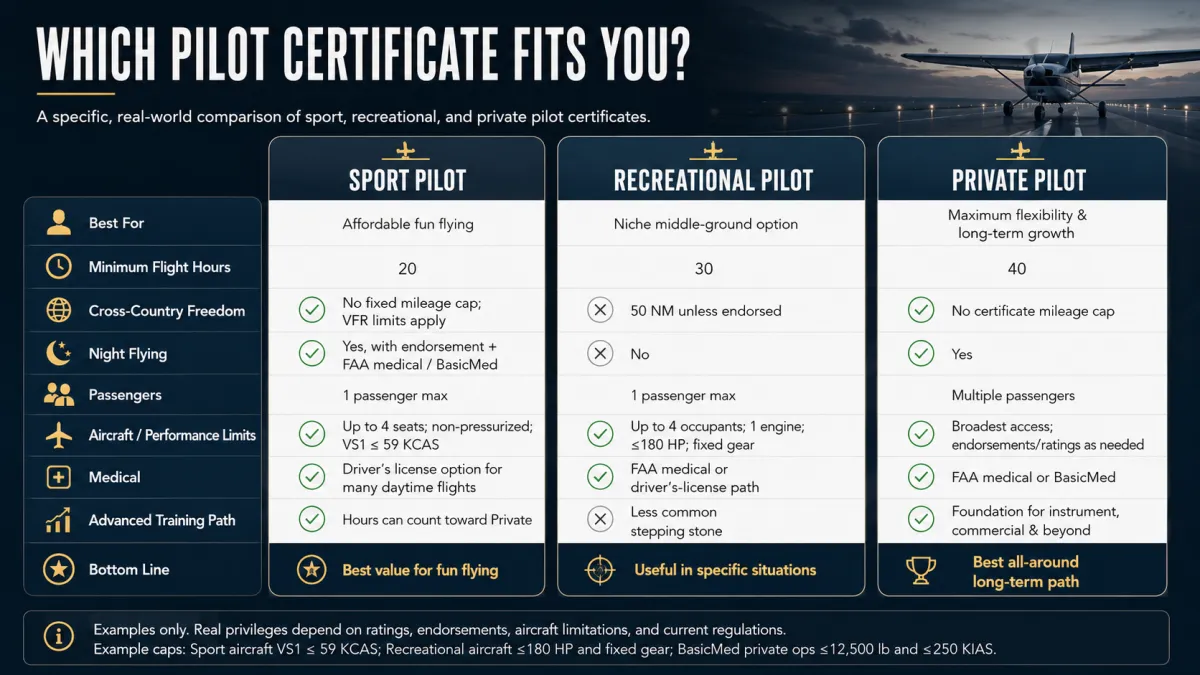
Pilot Certificate Paths
Here is what changed, and why it matters. The old rules limited sport pilots to small, light two-seat aircraft. Now, sport pilots can fly a much wider range of airplanes, including familiar four-seat trainers like the Cessna 172 and Piper Cherokee, as long as the aircraft meets certain performance limits. With the right training and endorsements, sport pilots can even fly at night and operate more capable aircraft than ever before.
One of the biggest draws remains the medical. For most daytime flying, a sport pilot can operate using a valid driver's license instead of an FAA medical certificate, which is a game changer for anyone who worries about the medical process. Do note that flying at night requires at least a BasicMed or FAA medical, and even in a four-seat airplane, a sport pilot may still carry only one passenger. But for flying for the pure joy of it, on your budget and your terms, sport pilot has never made more sense. And everything you learn counts toward a private certificate if you decide to go further.
Sport Pilot Certificate
Newly Expanded
Minimum 20 flight hours · Driver’s license medical option for most daytime flying · Great entry point into aviation
The sport pilot certificate is now the most accessible serious path into flying, and the recent MOSAIC rule change made it far more capable than it used to be. It requires fewer flight hours than a private certificate, with a minimum of 20 hours, which means less time and less money to get into the air.
Here is what changed, and why it matters. The old rules limited sport pilots to small, light two-seat aircraft. Now, sport pilots can fly a much wider range of airplanes, including familiar four-seat trainers like the Cessna 172 and Piper Cherokee, as long as the aircraft meets certain performance limits. With the right training and endorsements, sport pilots can even fly at night and operate more capable aircraft than ever before.
One of the biggest draws remains the medical. For most daytime flying, a sport pilot can operate using a valid driver's license instead of an FAA medical certificate, which is a game changer for anyone who worries about the medical process. Do note that flying at night requires at least a BasicMed or FAA medical, and even in a four-seat airplane, a sport pilot may still carry only one passenger. But for flying for the pure joy of it, on your budget and your terms, sport pilot has never made more sense. And everything you learn counts toward a private certificate if you decide to go further.
Recreational Pilot Certificate
Certificate
Between sport and private · More limitations than private · Less common path today
The recreational pilot certificate sits between sport and private. It requires more training than sport but less than a full private, and it carries its own limitations on distance, airspace, and aircraft. Honestly, with the recent expansion of sport pilot privileges, the recreational certificate has become an even less common choice, since most people find that sport pilot or private fits their goals more cleanly. It still exists, and for a specific pilot with specific needs it can occasionally make sense, but for most people the real decision is between sport and private. If you are curious whether it fits your situation, it is worth a quick conversation.
Which Path Is Right for You?
Guidance
Sport for affordable fun · Private for maximum freedom · A conversation helps narrow it down
Here is the honest guidance. If you want the fastest, most affordable way to fly for fun, especially if the FAA medical is a concern, the newly expanded sport pilot certificate is absolutely worth a serious look, and it can fly more airplane than most people realize. If you know you want the full freedom of flying, unlimited passengers, cross country without restrictions, flying in weather with an instrument rating, or any kind of career path, then starting straight into the private certificate is the better move, because everything builds from there. And if you are somewhere in between, that is exactly what a conversation is for. I will tell you the truth based on what you actually want, not what sells the most lessons.
READY TO GIVE US A TRY?
Call now to schedule!
Not sure which path fits you? That is the best possible reason to reach out. Tell me what you want out of flying, and I will help you find the most direct and affordable way to get there. No pressure, and no upselling you into more than you need.